KTG Property Solutions, Inc.
Timothy Cooprider
📞 561-756-2145
📍 231 Bradshaw Blvd, Perry, FL 32348
Timothy Cooprider
📞 561-756-2145
📍 231 Bradshaw Blvd, Perry, FL 32348
Alligators are protected by Florida law. Only licensed, state-permitted trappers are authorized to remove nuisance alligators. Do not approach, feed, or attempt to handle alligators yourself. Keep children and pets away from waterways where alligators may be present. Contact KTG Property Solutions for professional removal services.
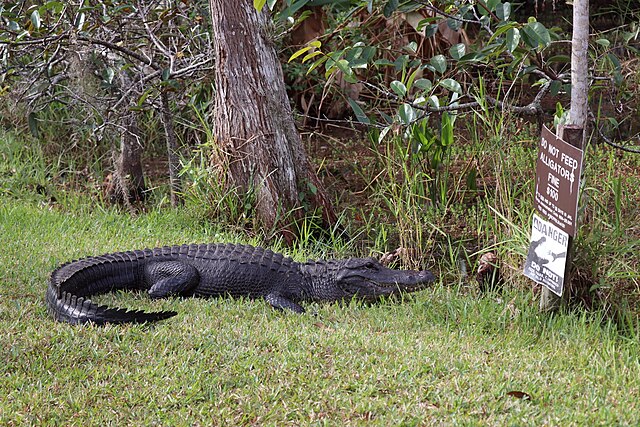
The American alligator (Alligator mississippiensis) is a large reptilian predator native to Florida and an integral part of the state's wetland ecosystems for millions of years. These powerful reptiles are easily recognized by their broad, rounded snouts, dark coloration ranging from black to olive-brown, and heavily armored bodies covered with bony plates called scutes. Adult males typically reach 10 to 15 feet in length and can weigh between 500 to 1,000 pounds, while females are generally smaller, averaging 8 to 10 feet and 200 to 300 pounds. Alligators are cold-blooded carnivores that feed primarily on fish, turtles, snakes, birds, and mammals. They are most active during warmer months and may be seen basking on banks or floating at the water's surface. As apex predators native to Florida, alligators play a crucial role in maintaining the health and balance of wetland ecosystems. They are a conservation success story, having recovered from near extinction in the 1960s to a thriving population today, though they remain protected under Florida law.
In their natural Florida environment, alligators inhabit freshwater systems including rivers, lakes, ponds, swamps, marshes, and canals. They prefer slow-moving or still waters with emergent vegetation that provides cover and basking sites. Alligators create and maintain important ecosystem features called "gator holes"—depressions they dig during dry seasons that hold water year-round, providing crucial habitat for fish, turtles, birds, and other wildlife during droughts. These gator holes serve as vital refuges for many species and help maintain biodiversity in Florida's wetlands. Alligators are territorial animals, with males establishing and defending territories ranging from a few acres to several square miles depending on habitat quality. They construct nests from vegetation mounds where females lay 30 to 50 eggs each summer. In Florida's natural landscape, alligators have historically occupied every freshwater habitat from the Everglades to river systems, cypress swamps, and coastal marshes. As native apex predators, they help control populations of prey species and maintain the ecological balance that has existed in Florida's waterways for millennia.
Alligators possess several remarkable adaptations that have allowed them to survive virtually unchanged for millions of years. They have one of the strongest bite forces in the animal kingdom, measured at over 2,900 pounds per square inch—powerful enough to crush turtle shells and large bones. Despite this tremendous bite force, the muscles that open their jaws are relatively weak, which is why their mouths can be held shut with moderate pressure. Alligators have excellent night vision due to a reflective layer behind their retinas that causes their eyes to glow red when light shines on them in darkness. They can remain submerged for over an hour by slowing their heart rate and metabolism. Alligators are also surprisingly vocal, producing a variety of sounds including bellows, hisses, and calls, with males performing impressive "water dances" during mating season where they create vibrations that make water droplets bounce off their backs. As ectothermic (cold-blooded) animals, they cannot regulate body temperature internally and must bask in the sun to warm up or enter water to cool down. Alligators continue growing throughout their lives, though growth slows significantly with age. These ancient reptiles can live 35 to 50 years in the wild, with some individuals exceeding 70 years in protected environments.
The dramatic expansion of residential development throughout Taylor County and surrounding Florida areas has created complex challenges involving alligator-human interactions as subdivisions increasingly encroach upon the wetland habitats these native reptiles have occupied for millions of years. As natural wetlands, ponds, and waterways are incorporated into developments for stormwater management and aesthetic amenities, alligators find themselves sharing space with human populations in ways that were rare just decades ago. Modern developments often feature retention ponds, lakes, canals, and waterfront properties that provide ideal alligator habitat but place these large predators in immediate proximity to homes, recreational areas, and people. This habitat overlap has led to increased encounters between alligators and humans, creating legitimate safety concerns, particularly for children, pets, and residents who may not understand alligator behavior or the risks involved. Alligators are naturally wary of humans, but they can lose this fear when people feed them—a dangerous and illegal practice that causes alligators to associate humans with food. Fed alligators become bold and aggressive, posing serious threats to public safety. Pets walking near water's edge, particularly small dogs, are at significant risk as they closely resemble natural alligator prey. The compression of habitat has not reduced alligator populations but rather concentrated them in smaller areas where they inevitably interact more frequently with humans. While alligators are an irreplaceable part of Florida's native wildlife heritage and protected by state law, professional management becomes necessary when individual alligators exhibit concerning behavior, frequent human-use areas, or pose imminent threats to public safety. Florida Fish and Wildlife Conservation Commission oversees the Statewide Nuisance Alligator Program, which authorizes licensed trappers to remove alligators that are at least four feet in length and pose a threat to people, pets, or property. It's critical to understand that removal of nuisance alligators is highly regulated and can only be performed by state-licensed trappers who follow strict protocols. In many cases involving nuisance alligators, particularly those over four feet or those that have lost fear of humans, removal and relocation or, when necessary for public safety, humane euthanasia may be required under state guidelines to protect both the human community and maintain the overall health of Florida's alligator populations.
Contact KTG Property Solutions for professional, state-licensed assessment and removal services.
Request Service